Loading...
Searching...
No Matches
cli::is_member_t Class Referenceexport
module cli11
Requires the value to appear in a set. More...
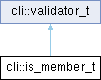
Inheritance diagram for cli::is_member_t:
Public Types | |
| using | filter_fn_t = std::function<std::string(std::string)> |
| A transformation applied to both sides of a comparison. | |
Public Member Functions | |
| template<typename T, typename... args_t> | |
| is_member_t (std::initializer_list< T > values, args_t &&...args) | |
| Constructs from an initializer list. | |
| template<typename T> | |
| is_member_t (T &&set) | |
| Constructs from a set, with no filtering. | |
| template<typename T, typename F> | |
| is_member_t (T set, F filter_function) | |
| Constructs from a set and one filter function. | |
| template<typename T, typename... args_t> | |
| is_member_t (T &&set, filter_fn_t filter_fn_1, filter_fn_t filter_fn_2, args_t &&...other) | |
| Constructs from a set and several filter functions, which nest. | |
| Public Member Functions inherited from cli::validator_t | |
| validator_t (std::string validator_desc) | |
| Constructs a validator that only carries a description. | |
| validator_t (std::function< std::string(std::string &)> op, std::string validator_desc, std::string validator_name="") | |
| Constructs a named validator. | |
| auto | operation (std::function< std::string(std::string &)> op) -> validator_t & |
| Replaces the check. | |
| auto | operator() (std::string &str) const -> std::string |
Runs the check, possibly rewriting str. | |
| auto | operator() (const std::string &str) const -> std::string |
Runs the check against a copy, leaving str untouched. | |
| auto | description (std::string validator_desc) -> validator_t & |
| Sets the description in place. | |
| auto | description (std::string validator_desc) const -> validator_t |
| Returns a copy carrying a different description. | |
| auto | get_description () const -> std::string |
| Returns the description shown in help output. | |
| auto | name (std::string validator_name) -> validator_t & |
| Sets the name in place. | |
| auto | name (std::string validator_name) const -> validator_t |
| Returns a copy carrying a different name. | |
| auto | get_name () const -> const std::string & |
| Returns the validator's name. | |
| auto | active (bool active_val=true) -> validator_t & |
| Enables or disables the check in place. | |
| auto | active (bool active_val=true) const -> validator_t |
| Returns a copy that is enabled or disabled. | |
| auto | get_active () const -> bool |
| Reports whether the check runs. | |
| auto | non_modifying (bool no_modify=true) -> validator_t & |
| Forbids or permits the check to rewrite its argument. | |
| auto | get_modifying () const -> bool |
| Reports whether the check may rewrite its argument. | |
| auto | application_index (int app_index) -> validator_t & |
| Sets which value the check applies to, in place. | |
| auto | application_index (int app_index) const -> validator_t |
| Returns a copy applying to a different value. | |
| auto | get_application_index () const -> int |
| Returns which value the check applies to. | |
| auto | operator& (const validator_t &other) const -> validator_t |
| Combines two validators so that both must pass. | |
| auto | operator| (const validator_t &other) const -> validator_t |
| Combines two validators so that either may pass. | |
| auto | operator! () const -> validator_t |
| Inverts a validator, so that passing becomes failing. | |
Additional Inherited Members | |
| Protected Member Functions inherited from cli::validator_t | |
| validator_t (std::string validator_desc, std::function< std::string(std::string &)> func) | |
| Constructs a validator with a fixed description. | |
| Protected Attributes inherited from cli::validator_t | |
| std::function< std::string()> | desc_function_ {[] { return std::string {}; }} |
| Produces the description shown in help output. | |
| std::function< std::string(std::string &)> | func_ |
| The check itself. | |
| std::string | name_ {} |
| The validator's name, used to find and replace it on an option. | |
| int | application_index_ = -1 |
| Which value this applies to, or -1 for all of them. | |
| bool | active_ {true} |
| Whether the check runs at all. | |
| bool | non_modifying_ {false} |
| Whether the check is forbidden from rewriting its argument. | |
Detailed Description
Requires the value to appear in a set.
The set may be passed by value, as an initializer list, or as a pointer, in which case it is held and re-read on each check, so a set that changes after construction still validates correctly.
One or more filter functions may be supplied; each is applied to both sides of the comparison, so is_member_t{set, cli::ignore_case} matches case-insensitively. On a filtered match the value is rewritten to the spelling stored in the set.
Constructor & Destructor Documentation
◆ is_member_t() [1/4]
template<typename T, typename... args_t>
|
inline |
Constructs from an initializer list.
- Parameters
-
values The permitted values. args Any filter functions.
◆ is_member_t() [2/4]
template<typename T>
|
inlineexplicit |
Constructs from a set, with no filtering.
- Parameters
-
set The permitted values, by value or by pointer.
◆ is_member_t() [3/4]
template<typename T, typename F>
|
inlineexplicit |
Constructs from a set and one filter function.
- Parameters
-
set The permitted values, by value or by pointer. filter_function Applied to both sides of each comparison.
◆ is_member_t() [4/4]
template<typename T, typename... args_t>
|
inline |
Constructs from a set and several filter functions, which nest.
- Parameters
-
set The permitted values, by value or by pointer. filter_fn_1 The first filter, applied innermost. filter_fn_2 The second filter. other Any further filters.
The documentation for this class was generated from the following file:
- /home/mccakit/desktop/repositories/cli11/src/extra_validators.cpp