Loading...
Searching...
No Matches
cli::option_t Class Referenceexport
module cli11
One command-line option, flag, or positional argument. More...
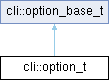
Inheritance diagram for cli::option_t:
Public Member Functions | |
| option_t (const option_t &)=delete | |
| auto | operator= (const option_t &) -> option_t &=delete |
| auto | count () const -> std::size_t |
| Returns how many values were collected. | |
| auto | empty () const -> bool |
| Reports whether no values were collected. | |
| operator bool () const | |
| Reports whether the option was used. | |
| auto | clear () -> void |
| Discards collected values and resets the parse state. | |
| template<typename T = app_t> | |
| auto | ignore_case (bool value=true) -> option_t * |
| Makes name matching case-insensitive. | |
| template<typename T = app_t> | |
| auto | ignore_underscore (bool value=true) -> option_t * |
| Makes name matching ignore underscores. | |
| auto | multi_option_policy (multi_option_policy_t value=multi_option_policy_t::reject) -> option_t * |
| Sets what happens to surplus values. | |
| auto | disable_flag_override (bool value=true) -> option_t * |
| Rejects --no-flag style overrides. | |
Setting options | |
| auto | expected (int value) -> option_t * |
| Sets how many values the option accepts. | |
| auto | expected (int value_min, int value_max) -> option_t * |
| Sets the range of value counts the option accepts. | |
| auto | allow_extra_args (bool value=true) -> option_t * |
| Allows the option to absorb surplus arguments. | |
| auto | get_allow_extra_args () const -> bool |
| Reports whether the option absorbs surplus arguments. | |
| auto | trigger_on_parse (bool value=true) -> option_t * |
| Runs the callback as soon as a value is parsed. | |
| auto | get_trigger_on_parse () const -> bool |
| Reports whether the callback runs during parsing. | |
| auto | force_callback (bool value=true) -> option_t * |
| Runs the callback even when the option is absent. | |
| auto | get_force_callback () const -> bool |
| Reports whether the callback runs when the option is absent. | |
| auto | run_callback_for_default (bool value=true) -> option_t * |
| Runs the callback when only the default value is present. | |
| auto | get_run_callback_for_default () const -> bool |
| Reports whether the callback runs for default values. | |
| auto | callback_priority (callback_priority_t value=callback_priority_t::normal) -> option_t * |
| Sets when this option's callback runs. | |
Validators and transforms | |
A check inspects a value; a transform rewrites it. Checks are appended and run after any transforms, which are prepended. | |
| auto | check (validator_ptr_t validator) -> option_t * |
| Appends a shared validator as a check. | |
| auto | check (validator_t validator, const std::string &validator_name="") -> option_t * |
| Appends a validator as a check. | |
| auto | check (std::function< std::string(const std::string &)> validator_func, std::string validator_description="", std::string validator_name="") -> option_t * |
| Appends a callable as a check. | |
| auto | transform (validator_ptr_t validator) -> option_t * |
| Prepends a shared validator as a transform. | |
| auto | transform (validator_t validator, const std::string &transform_name="") -> option_t * |
| Prepends a validator as a transform. | |
| auto | transform (std::function< std::string(std::string)> transform_func, std::string transform_description="", std::string transform_name="") -> option_t * |
| Prepends a callable as a transform. | |
| auto | each (std::function< void(std::string)> func) -> option_t * |
| Appends a callable run once per value, for its side effects. | |
| auto | get_validator (const std::string &validator_name="") -> validator_t * |
| Finds a validator by name. | |
| auto | get_validator (int index) -> validator_t * |
| Finds a validator by position. | |
Dependencies | |
| auto | needs (option_t *opt) -> option_t * |
| Requires another option to appear alongside this one. | |
| template<typename T = app_t> | |
| auto | needs (std::string opt_name) -> option_t * |
| Requires a named option to appear alongside this one. | |
| template<typename A, typename B, typename... args_t> | |
| auto | needs (A opt, B opt1, args_t... args) -> option_t * |
| Requires several options to appear alongside this one. | |
| auto | remove_needs (option_t *opt) -> bool |
| Drops a dependency. | |
| auto | excludes (option_t *opt) -> option_t * |
| Forbids another option from appearing alongside this one. | |
| template<typename T = app_t> | |
| auto | excludes (std::string opt_name) -> option_t * |
| Forbids a named option from appearing alongside this one. | |
| template<typename A, typename B, typename... args_t> | |
| auto | excludes (A opt, B opt1, args_t... args) -> option_t * |
| Forbids several options from appearing alongside this one. | |
| auto | remove_excludes (option_t *opt) -> bool |
| Drops an exclusion. | |
| auto | envname (std::string name) -> option_t * |
| Sets the environment variable consulted when the option is absent. | |
Accessors | |
| auto | get_type_size () const -> int |
| Returns the smallest number of values one appearance consumes. | |
| auto | get_type_size_min () const -> int |
| Returns the smallest number of values one appearance consumes. | |
| auto | get_type_size_max () const -> int |
| Returns the largest number of values one appearance consumes. | |
| auto | get_inject_separator () const -> bool |
| Reports whether a separator is inserted between value groups. | |
| auto | get_envname () const -> const std::string & |
| Returns the environment variable consulted when the option is absent. | |
| auto | get_needs () const -> const std::set< option_t * > & |
| Returns the options this one depends on. | |
| auto | get_excludes () const -> const std::set< option_t * > & |
| Returns the options this one excludes. | |
| auto | get_default_str () const -> const std::string & |
| Returns the default value as shown in help output. | |
| auto | get_callback () const -> const callback_t & |
| Returns the callback that writes the bound variable. | |
| auto | get_lnames () const -> const std::vector< std::string > & |
| Returns the long names, without their leading dashes. | |
| auto | get_snames () const -> const std::vector< std::string > & |
| Returns the short names, without their leading dash. | |
| auto | get_fnames () const -> const std::vector< std::string > & |
| Returns the flag names. | |
| auto | get_single_name () const -> const std::string & |
| Returns one representative name for this option. | |
| auto | get_expected () const -> int |
| Returns the smallest number of values accepted in total. | |
| auto | get_expected_min () const -> int |
| Returns the smallest number of values accepted in total. | |
| auto | get_expected_max () const -> int |
| Returns the largest number of values accepted in total. | |
| auto | get_items_expected_min () const -> int |
| Returns the smallest total number of items accepted. | |
| auto | get_items_expected_max () const -> int |
| Returns the largest total number of items accepted. | |
| auto | get_items_expected () const -> int |
| Returns the smallest total number of items accepted. | |
| auto | get_positional () const -> bool |
| Reports whether this option is a positional. | |
| auto | nonpositional () const -> bool |
| Reports whether this option has a dashed name. | |
| auto | has_description () const -> bool |
| Reports whether a description was set. | |
| auto | get_description () const -> const std::string & |
| Returns the description shown in help output. | |
| auto | description (std::string option_description) -> option_t * |
| Sets the description shown in help output. | |
| auto | option_text (std::string text) -> option_t * |
| Replaces the generated type name in help output. | |
| auto | get_option_text () const -> const std::string & |
| Returns the text replacing the generated type name. | |
Help output | |
| auto | get_name (bool positional=false, bool all_options=false, bool disable_default_flag_values=false) const -> std::string |
| Renders this option's name for help output. | |
Parsing | |
| auto | run_callback () -> void |
| Validates, reduces, and hands the results to the callback. | |
| auto | matching_name (const option_t &other) const -> const std::string & |
| Returns the first name this option shares with another. | |
| auto | operator== (const option_t &other) const -> bool |
| Reports whether two options share a name. | |
| auto | check_name (const std::string &name) const -> bool |
| Reports whether a command-line token names this option. | |
| auto | check_sname (std::string name) const -> bool |
| Reports whether a short name belongs to this option. | |
| auto | check_lname (std::string name) const -> bool |
| Reports whether a long name belongs to this option. | |
| auto | check_fname (std::string name) const -> bool |
| Reports whether a flag name belongs to this option. | |
| auto | get_flag_value (const std::string &name, std::string input_value) const -> std::string |
| Resolves the value a flag contributes. | |
| auto | add_result (std::string s) -> option_t * |
| Adds one raw result, resetting the parse state. | |
| auto | add_result (std::string s, int &results_added) -> option_t * |
| Adds one raw result and reports how many entries it produced. | |
| auto | add_result (std::vector< std::string > s) -> option_t * |
| Adds several raw results, resetting the parse state. | |
| auto | results () const -> const results_t & |
| Returns the raw results, before validation or reduction. | |
| auto | reduced_results () const -> results_t |
| Returns the results after validation and reduction. | |
| template<typename T> | |
| auto | results (T &output) const -> void |
Converts the results into a value of type T. | |
| template<typename T> | |
| auto | as () const -> T |
| Converts the results and returns them. | |
| auto | get_callback_run () const -> bool |
| Reports whether the callback has already run. | |
Type presentation | |
| auto | type_name_fn (std::function< std::string()> typefun) -> option_t * |
| Sets the callable producing the type name shown in help output. | |
| auto | type_name (std::string typeval) -> option_t * |
| Sets a fixed type name for help output. | |
| auto | type_size (int option_type_size) -> option_t * |
| Sets how many values one appearance consumes. | |
| auto | type_size (int option_type_size_min, int option_type_size_max) -> option_t * |
| Sets the range of values one appearance may consume. | |
| auto | inject_separator (bool value=true) -> void |
| Sets whether a separator is inserted between value groups. | |
Default values | |
| auto | default_function (std::function< std::string()> func) -> option_t * |
| Sets the callable that produces the printed default. | |
| auto | capture_default_str () -> option_t * |
| Evaluates the default function and records the result. | |
| auto | default_str (std::string val) -> option_t * |
| Sets the printed default directly. | |
| template<typename X> | |
| auto | default_val (const X &val) -> option_t * |
| Sets the default from a typed value, checking that it converts. | |
| auto | get_type_name () const -> std::string |
| Returns the type name shown in help output. | |
| Public Member Functions inherited from cli::option_base_t | |
| template<typename self_t> | |
| auto | group (this self_t &self, const std::string &name) -> self_t * |
| Sets the help group this option is listed under. | |
| template<typename self_t> | |
| auto | required (this self_t &self, bool value=true) -> self_t * |
| Marks the option as required. | |
| template<typename self_t> | |
| auto | mandatory (this self_t &self, bool value=true) -> self_t * |
| Marks the option as required. | |
| template<typename self_t> | |
| auto | always_capture_default (this self_t &self, bool value=true) -> self_t * |
| Captures the bound variable's value as the printed default. | |
| auto | get_group () const -> const std::string & |
| Returns the help group this option is listed under. | |
| auto | get_required () const -> bool |
| Reports whether the option must appear. | |
| auto | get_ignore_case () const -> bool |
| Reports whether name matching ignores case. | |
| auto | get_ignore_underscore () const -> bool |
| Reports whether name matching ignores underscores. | |
| auto | get_configurable () const -> bool |
| Reports whether the option may be set from a configuration file. | |
| auto | get_disable_flag_override () const -> bool |
| Reports whether flag overrides are rejected. | |
| auto | get_delimiter () const -> char |
| Returns the character that splits a value into several. | |
| auto | get_always_capture_default () const -> bool |
| Reports whether defaults are captured automatically. | |
| auto | get_multi_option_policy () const -> multi_option_policy_t |
| Returns what happens to surplus values. | |
| auto | get_callback_priority () const -> callback_priority_t |
| Returns when this option's callback runs. | |
| template<typename self_t> | |
| auto | take_last (this self_t &self) -> self_t * |
| Keeps only the last value given. | |
| template<typename self_t> | |
| auto | take_first (this self_t &self) -> self_t * |
| Keeps only the first value given. | |
| template<typename self_t> | |
| auto | take_all (this self_t &self) -> self_t * |
| Keeps every value given. | |
| template<typename self_t> | |
| auto | join (this self_t &self) -> self_t * |
| Joins every value given. | |
| template<typename self_t> | |
| auto | join (this self_t &self, char delim) -> self_t * |
| Joins every value given, using a specific delimiter. | |
| template<typename self_t> | |
| auto | configurable (this self_t &self, bool value=true) -> self_t * |
| Allows or forbids setting the option from a configuration file. | |
| template<typename self_t> | |
| auto | delimiter (this self_t &self, char value='\0') -> self_t * |
| Sets the character that splits a value into several. | |
Protected Types | |
| enum class | option_state_t : std::uint8_t { parsing = 0 , validated = 2 , reduced = 4 , callback_run = 6 } |
| How far an option has progressed through parsing. More... | |
Protected Member Functions | |
| option_t (std::string option_name, std::string option_description, callback_t callback, app_t *parent, bool allow_non_standard=false) | |
| Constructs an option from a name specification. | |
| Protected Member Functions inherited from cli::option_base_t | |
| template<typename T> | |
| auto | copy_to (T *other) const -> void |
| Copies every shared setting onto another option. | |
Protected Attributes | |
| std::vector< std::string > | snames_ {} |
| Short names, without their leading dash. | |
| std::vector< std::string > | lnames_ {} |
| Long names, without their leading dashes. | |
| std::vector< std::pair< std::string, std::string > > | default_flag_values_ {} |
| Flag names paired with the default value each implies. | |
| std::vector< std::string > | fnames_ {} |
| Every flag name, in the order given. | |
| std::string | pname_ {} |
| The positional name, empty if this is not a positional. | |
| std::string | envname_ {} |
| The environment variable consulted when the option is absent. | |
| std::string | description_ {} |
| The description shown in help output. | |
| std::string | default_str_ {} |
| The default value as shown in help output. | |
| std::string | option_text_ {} |
| Text replacing the generated type name in help output. | |
| std::function< std::string()> | type_name_ {[] { return std::string(); }} |
| Produces the type name shown in help output. | |
| std::function< std::string()> | default_function_ {} |
| Produces the default value shown in help output. | |
| int | type_size_max_ {1} |
| Largest number of values one appearance consumes. | |
| int | type_size_min_ {1} |
| Smallest number of values one appearance consumes. | |
| int | expected_min_ {1} |
| Smallest number of values accepted in total. | |
| int | expected_max_ {1} |
| Largest number of values accepted in total. | |
| std::vector< validator_ptr_t > | validators_ {} |
| Validators and transforms, applied in order. | |
| std::set< option_t * > | needs_ {} |
| Options that must also appear. | |
| std::set< option_t * > | excludes_ {} |
| Options that must not appear alongside this one. | |
| app_t * | parent_ {nullptr} |
| The application this option belongs to. | |
| callback_t | callback_ {} |
| Writes the collected results into the bound variable. | |
| results_t | results_ {} |
| The raw strings collected during parsing. | |
| results_t | proc_results_ {} |
| The results after validation and reduction. | |
| option_state_t | current_option_state_ {option_state_t::parsing} |
| How far this option has progressed. | |
| bool | allow_extra_args_ {false} |
| Whether surplus arguments are absorbed by this option. | |
| bool | flag_like_ {false} |
| Whether this option behaves like a flag. | |
| bool | run_callback_for_default_ {false} |
| Whether the callback runs even when only the default is present. | |
| bool | inject_separator_ {false} |
| Whether a separator is inserted between value groups. | |
| bool | trigger_on_result_ {false} |
| Whether the callback runs as soon as a value is parsed. | |
| bool | force_callback_ {false} |
| Whether the callback runs even when the option is absent. | |
| Protected Attributes inherited from cli::option_base_t | |
| std::string | group_ = std::string("OPTIONS") |
| The help group this option is listed under. | |
| bool | required_ {false} |
| Whether the option must appear. | |
| bool | ignore_case_ {false} |
| Whether name matching ignores case. | |
| bool | ignore_underscore_ {false} |
| Whether name matching ignores underscores. | |
| bool | configurable_ {true} |
| Whether the option may be set from a configuration file. | |
| bool | disable_flag_override_ {false} |
| Whether --no-flag style overrides are rejected. | |
| char | delimiter_ {'\0'} |
| Character that splits a single value into several. | |
| bool | always_capture_default_ {false} |
| Whether the bound value's default is captured automatically. | |
| multi_option_policy_t | multi_option_policy_ {multi_option_policy_t::reject} |
| What to do with surplus values. | |
| callback_priority_t | callback_priority_ {callback_priority_t::normal} |
| When this option's callback runs. | |
Detailed Description
One command-line option, flag, or positional argument.
Not constructed directly; app_t::add_option, add_flag, and their relatives create these and hand back a pointer for chaining.
Member Enumeration Documentation
◆ option_state_t
|
strongprotected |
Constructor & Destructor Documentation
◆ option_t()
|
inlineprotected |
Constructs an option from a name specification.
- Parameters
-
option_name The name specification, for example "-f,--file". option_description The description shown in help output. callback Writes collected results into the bound variable. parent The owning application. allow_non_standard Accept multi-character short names.
- Exceptions
-
cli::bad_name_string_t If the specification is malformed.
Member Function Documentation
◆ add_result() [1/3]
|
inline |
Adds one raw result, resetting the parse state.
- Parameters
-
s The result to add.
- Returns
- A pointer to this option, for chaining.
◆ add_result() [2/3]
|
inline |
Adds one raw result and reports how many entries it produced.
A delimited value can expand into several entries.
- Parameters
-
[in] s The result to add. [out] results_added How many entries were appended.
- Returns
- A pointer to this option, for chaining.
◆ add_result() [3/3]
|
inline |
Adds several raw results, resetting the parse state.
- Parameters
-
s The results to add.
- Returns
- A pointer to this option, for chaining.
◆ allow_extra_args()
|
inline |
Allows the option to absorb surplus arguments.
- Parameters
-
value Whether to absorb surplus arguments.
- Returns
- A pointer to this option, for chaining.
◆ as()
template<typename T>
|
inlinenodiscard |
Converts the results and returns them.
- Template Parameters
-
T The type to convert to.
- Returns
- The converted value.
- Exceptions
-
cli::conversion_error_t If the results cannot be converted.
◆ callback_priority()
|
inline |
Sets when this option's callback runs.
- Parameters
-
value The callback priority.
- Returns
- A pointer to this option, for chaining.
◆ capture_default_str()
|
inline |
Evaluates the default function and records the result.
Does nothing when no default function is set.
- Returns
- A pointer to this option, for chaining.
◆ check() [1/3]
|
inline |
Appends a callable as a check.
- Parameters
-
validator_func Returns an empty string on success, else a message. validator_description The description shown in help output. validator_name A name to find it by later.
- Returns
- A pointer to this option, for chaining.
◆ check() [2/3]
|
inline |
Appends a shared validator as a check.
- Parameters
-
validator The validator to append.
- Returns
- A pointer to this option, for chaining.
◆ check() [3/3]
|
inline |
Appends a validator as a check.
- Parameters
-
validator The validator to append. validator_name A name to find it by later.
- Returns
- A pointer to this option, for chaining.
◆ check_fname()
|
inlinenodiscard |
Reports whether a flag name belongs to this option.
- Parameters
-
name The name to test.
- Returns
- true if the name matches.
◆ check_lname()
|
inlinenodiscard |
Reports whether a long name belongs to this option.
- Parameters
-
name The name to test, without its dashes.
- Returns
- true if the name matches.
◆ check_name()
|
inlinenodiscard |
Reports whether a command-line token names this option.
Accepts --long, -s, a bare positional name, or the environment variable name.
- Parameters
-
name The token to test.
- Returns
- true if the token names this option.
◆ check_sname()
|
inlinenodiscard |
Reports whether a short name belongs to this option.
- Parameters
-
name The name to test, without its dash.
- Returns
- true if the name matches.
◆ count()
|
inlinenodiscard |
Returns how many values were collected.
- Returns
- The result count.
◆ default_function()
|
inline |
Sets the callable that produces the printed default.
The callable is not invoked here; call capture_default_str to evaluate it.
- Parameters
-
func Produces the printed default.
- Returns
- A pointer to this option, for chaining.
◆ default_str()
|
inline |
Sets the printed default directly.
- Parameters
-
val The default as it should appear in help output.
- Returns
- A pointer to this option, for chaining.
◆ default_val()
template<typename X>
|
inline |
Sets the default from a typed value, checking that it converts.
The value is pushed through the option's own conversion and validation path so that an unusable default is reported at construction rather than at parse time. The option's results and state are restored afterwards, including when conversion throws.
- Template Parameters
-
X The type of the supplied value.
- Parameters
-
val The default value.
- Returns
- A pointer to this option, for chaining.
- Exceptions
-
cli::conversion_error_t If the value cannot be converted.
◆ description()
|
inline |
Sets the description shown in help output.
- Parameters
-
option_description The new description.
- Returns
- A pointer to this option, for chaining.
◆ disable_flag_override()
|
inline |
Rejects --no-flag style overrides.
- Parameters
-
value Whether to reject overrides.
- Returns
- A pointer to this option, for chaining.
◆ each()
|
inline |
Appends a callable run once per value, for its side effects.
- Parameters
-
func The callable to run.
- Returns
- A pointer to this option, for chaining.
◆ empty()
|
inlinenodiscard |
Reports whether no values were collected.
- Returns
- true if nothing was collected.
◆ envname()
|
inline |
Sets the environment variable consulted when the option is absent.
- Parameters
-
name The variable name.
- Returns
- A pointer to this option, for chaining.
◆ excludes() [1/3]
template<typename A, typename B, typename... args_t>
|
inline |
Forbids several options from appearing alongside this one.
- Parameters
-
opt The first excluded option. opt1 The second excluded option. args Any further excluded options.
- Returns
- A pointer to this option, for chaining.
◆ excludes() [2/3]
Forbids another option from appearing alongside this one.
The exclusion is recorded on both options.
- Parameters
-
opt The option to exclude.
- Returns
- A pointer to this option, for chaining.
- Exceptions
-
cli::incorrect_construction_t If optis this option.
◆ excludes() [3/3]
template<typename T = app_t>
|
inline |
Forbids a named option from appearing alongside this one.
- Template Parameters
-
T The application type to look the name up on.
- Parameters
-
opt_name The name of the excluded option.
- Returns
- A pointer to this option, for chaining.
- Exceptions
-
cli::incorrect_construction_t If no such option exists.
◆ expected() [1/2]
|
inline |
Sets how many values the option accepts.
A negative value sets a minimum with no maximum. Zero makes the option behave as a flag.
- Parameters
-
value The value count.
- Returns
- A pointer to this option, for chaining.
◆ expected() [2/2]
|
inline |
Sets the range of value counts the option accepts.
Negative bounds are treated as their magnitude, except that a negative maximum means unbounded. The bounds are swapped if given in the wrong order.
- Parameters
-
value_min The smallest acceptable count. value_max The largest acceptable count.
- Returns
- A pointer to this option, for chaining.
◆ force_callback()
|
inline |
Runs the callback even when the option is absent.
- Parameters
-
value Whether to force the callback.
- Returns
- A pointer to this option, for chaining.
◆ get_allow_extra_args()
|
inlinenodiscard |
Reports whether the option absorbs surplus arguments.
- Returns
- true if surplus arguments are absorbed.
◆ get_callback()
|
inlinenodiscard |
Returns the callback that writes the bound variable.
- Returns
- The callback.
◆ get_callback_run()
|
inlinenodiscard |
Reports whether the callback has already run.
- Returns
- true if the callback has run.
◆ get_default_str()
|
inlinenodiscard |
Returns the default value as shown in help output.
- Returns
- The rendered default.
◆ get_description()
|
inlinenodiscard |
Returns the description shown in help output.
- Returns
- The description.
◆ get_envname()
|
inlinenodiscard |
Returns the environment variable consulted when the option is absent.
- Returns
- The variable name, empty if none is set.
◆ get_excludes()
|
inlinenodiscard |
Returns the options this one excludes.
- Returns
- The exclusion set.
◆ get_expected()
|
inlinenodiscard |
Returns the smallest number of values accepted in total.
- Returns
- The value count.
◆ get_expected_max()
|
inlinenodiscard |
Returns the largest number of values accepted in total.
- Returns
- The value count.
◆ get_expected_min()
|
inlinenodiscard |
Returns the smallest number of values accepted in total.
- Returns
- The value count.
◆ get_flag_value()
|
inlinenodiscard |
Resolves the value a flag contributes.
With no explicit value the flag's registered default is used. A negated flag inverts whatever was supplied. When overrides are disabled, any value other than the registered one is rejected.
- Parameters
-
name The flag name as written on the command line. input_value The value supplied with it, if any.
- Returns
- The resolved value.
- Exceptions
-
cli::argument_mismatch_t If an override is supplied but disabled.
◆ get_fnames()
|
inlinenodiscard |
Returns the flag names.
- Returns
- The flag names.
◆ get_force_callback()
|
inlinenodiscard |
Reports whether the callback runs when the option is absent.
- Returns
- true if the callback is forced.
◆ get_inject_separator()
|
inlinenodiscard |
Reports whether a separator is inserted between value groups.
- Returns
- true if a separator is inserted.
◆ get_items_expected()
|
inlinenodiscard |
Returns the smallest total number of items accepted.
- Returns
- The item count.
◆ get_items_expected_max()
|
inlinenodiscard |
Returns the largest total number of items accepted.
Saturates rather than overflowing: if the product does not fit, the unbounded sentinel is reported instead.
- Returns
- The item count.
◆ get_items_expected_min()
|
inlinenodiscard |
Returns the smallest total number of items accepted.
- Returns
- The item count.
◆ get_lnames()
|
inlinenodiscard |
Returns the long names, without their leading dashes.
- Returns
- The long names.
◆ get_name()
|
inlinenodiscard |
Renders this option's name for help output.
Returns an empty string when the option has no group, since a group-less option is hidden.
- Parameters
-
positional Prefer the positional name. all_options List every name rather than one representative. disable_default_flag_values Omit the {value} suffix on flags.
- Returns
- The rendered name.
◆ get_needs()
|
inlinenodiscard |
Returns the options this one depends on.
- Returns
- The dependency set.
◆ get_option_text()
|
inlinenodiscard |
Returns the text replacing the generated type name.
- Returns
- The replacement text, empty if none is set.
◆ get_positional()
|
inlinenodiscard |
Reports whether this option is a positional.
- Returns
- true if a positional name is set.
◆ get_run_callback_for_default()
|
inlinenodiscard |
Reports whether the callback runs for default values.
- Returns
- true if the callback runs for defaults.
◆ get_single_name()
|
inlinenodiscard |
Returns one representative name for this option.
Prefers the first long name, then the first short name, then the positional name, then the environment variable name.
- Returns
- The chosen name.
◆ get_snames()
|
inlinenodiscard |
Returns the short names, without their leading dash.
- Returns
- The short names.
◆ get_trigger_on_parse()
|
inlinenodiscard |
Reports whether the callback runs during parsing.
- Returns
- true if the callback is triggered during parsing.
◆ get_type_name()
|
inlinenodiscard |
Returns the type name shown in help output.
The generated type name with each validator's description appended, separated by colons.
- Returns
- The rendered type name.
◆ get_type_size()
|
inlinenodiscard |
Returns the smallest number of values one appearance consumes.
- Returns
- The value count.
◆ get_type_size_max()
|
inlinenodiscard |
Returns the largest number of values one appearance consumes.
- Returns
- The value count.
◆ get_type_size_min()
|
inlinenodiscard |
Returns the smallest number of values one appearance consumes.
- Returns
- The value count.
◆ get_validator() [1/2]
|
inline |
Finds a validator by name.
An empty name returns the first validator.
- Parameters
-
validator_name The name to look for.
- Returns
- A pointer to the validator.
- Exceptions
-
cli::option_not_found_t If no validator matches.
◆ get_validator() [2/2]
|
inline |
Finds a validator by position.
- Parameters
-
index The position to look up.
- Returns
- A pointer to the validator.
- Exceptions
-
cli::option_not_found_t If indexis out of range.
◆ has_description()
|
inlinenodiscard |
Reports whether a description was set.
- Returns
- true if the description is not empty.
◆ ignore_case()
template<typename T = app_t>
|
inline |
Makes name matching case-insensitive.
Enabling this can make two previously distinct options collide, so the sibling options are rescanned and the change is rolled back on conflict.
- Template Parameters
-
T The application type holding the sibling options.
- Parameters
-
value Whether to ignore case.
- Returns
- A pointer to this option, for chaining.
- Exceptions
-
cli::option_already_added_t If the change causes a name conflict.
◆ ignore_underscore()
template<typename T = app_t>
|
inline |
Makes name matching ignore underscores.
Enabling this can make two previously distinct options collide, so the sibling options are rescanned and the change is rolled back on conflict.
- Template Parameters
-
T The application type holding the sibling options.
- Parameters
-
value Whether to ignore underscores.
- Returns
- A pointer to this option, for chaining.
- Exceptions
-
cli::option_already_added_t If the change causes a name conflict.
◆ inject_separator()
|
inline |
Sets whether a separator is inserted between value groups.
- Parameters
-
value Whether to insert a separator.
◆ matching_name()
|
inlinenodiscard |
Returns the first name this option shares with another.
Two options conflict if any of their names collide. When both are configurable the comparison is looser, because a configuration file does not distinguish short from long names.
- Parameters
-
other The option to compare against.
- Returns
- The colliding name, or an empty string if there is none.
◆ multi_option_policy()
|
inline |
Sets what happens to surplus values.
Moving away from multi_option_policy_t::reject on an unbounded option pins the maximum to the minimum, and resets the parse state so that already-collected results are reduced under the new policy.
- Parameters
-
value The policy to apply.
- Returns
- A pointer to this option, for chaining.
◆ needs() [1/3]
template<typename A, typename B, typename... args_t>
|
inline |
Requires several options to appear alongside this one.
- Parameters
-
opt The first required option. opt1 The second required option. args Any further required options.
- Returns
- A pointer to this option, for chaining.
◆ needs() [2/3]
Requires another option to appear alongside this one.
Self-dependency is ignored rather than reported.
- Parameters
-
opt The option that must also appear.
- Returns
- A pointer to this option, for chaining.
◆ needs() [3/3]
template<typename T = app_t>
|
inline |
Requires a named option to appear alongside this one.
- Template Parameters
-
T The application type to look the name up on.
- Parameters
-
opt_name The name of the required option.
- Returns
- A pointer to this option, for chaining.
- Exceptions
-
cli::incorrect_construction_t If no such option exists.
◆ nonpositional()
|
inlinenodiscard |
Reports whether this option has a dashed name.
- Returns
- true if a short or long name is set.
◆ operator bool()
|
inlineexplicit |
Reports whether the option was used.
- Returns
- true if values were collected or the callback is forced.
◆ operator==()
|
inlinenodiscard |
Reports whether two options share a name.
- Parameters
-
other The option to compare against.
- Returns
- true if any name collides.
◆ option_text()
|
inline |
Replaces the generated type name in help output.
- Parameters
-
text The replacement text.
- Returns
- A pointer to this option, for chaining.
◆ reduced_results()
|
inlinenodiscard |
Returns the results after validation and reduction.
Runs whichever stages have not yet run, without changing the option's recorded state.
- Returns
- The processed results.
◆ remove_excludes()
|
inline |
Drops an exclusion.
- Parameters
-
opt The option to stop excluding.
- Returns
- true if the exclusion was present.
◆ remove_needs()
|
inline |
Drops a dependency.
- Parameters
-
opt The option to stop requiring.
- Returns
- true if the dependency was present.
◆ results() [1/2]
|
inlinenodiscard |
Returns the raw results, before validation or reduction.
- Returns
- The raw results.
◆ results() [2/2]
template<typename T>
|
inline |
Converts the results into a value of type T.
Falls back to the printed default when nothing was collected, and to a value-initialised result when there is no default either.
- Template Parameters
-
T The type to convert to.
- Parameters
-
[out] output The value to fill.
- Exceptions
-
cli::conversion_error_t If the results cannot be converted.
◆ run_callback()
|
inline |
Validates, reduces, and hands the results to the callback.
Advances the option through option_state_t, skipping stages that have already run. When the callback is forced and nothing was collected, the printed default is used and then discarded again.
- Exceptions
-
cli::conversion_error_t If the callback rejects the results.
◆ run_callback_for_default()
|
inline |
Runs the callback when only the default value is present.
- Parameters
-
value Whether to run the callback for defaults.
- Returns
- A pointer to this option, for chaining.
◆ transform() [1/3]
|
inline |
Prepends a callable as a transform.
- Parameters
-
transform_func Returns the rewritten value. transform_description The description shown in help output. transform_name A name to find it by later.
- Returns
- A pointer to this option, for chaining.
◆ transform() [2/3]
|
inline |
Prepends a shared validator as a transform.
- Parameters
-
validator The validator to prepend.
- Returns
- A pointer to this option, for chaining.
◆ transform() [3/3]
|
inline |
Prepends a validator as a transform.
- Parameters
-
validator The validator to prepend. transform_name A name to find it by later.
- Returns
- A pointer to this option, for chaining.
◆ trigger_on_parse()
|
inline |
Runs the callback as soon as a value is parsed.
- Parameters
-
value Whether to trigger during parsing.
- Returns
- A pointer to this option, for chaining.
◆ type_name()
|
inline |
Sets a fixed type name for help output.
- Parameters
-
typeval The type name.
- Returns
- A pointer to this option, for chaining.
◆ type_name_fn()
|
inline |
Sets the callable producing the type name shown in help output.
- Parameters
-
typefun Produces the type name.
- Returns
- A pointer to this option, for chaining.
◆ type_size() [1/2]
|
inline |
Sets how many values one appearance consumes.
A negative value fixes the per-appearance count and makes the total unbounded. A count of zero makes the option optional.
- Parameters
-
option_type_size The value count.
- Returns
- A pointer to this option, for chaining.
◆ type_size() [2/2]
|
inline |
Sets the range of values one appearance may consume.
Negative bounds are treated as their magnitude and make the total unbounded. The bounds are swapped if given in the wrong order.
- Parameters
-
option_type_size_min The smallest value count. option_type_size_max The largest value count.
- Returns
- A pointer to this option, for chaining.
The documentation for this class was generated from the following file:
- /home/mccakit/desktop/repositories/cli11/src/option.cpp