Loading...
Searching...
No Matches
fmt::BasicMemoryBuffer< T, SIZE, Allocator > Class Template Referenceexport
module fmt
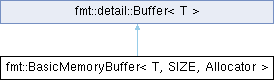
Inheritance diagram for fmt::BasicMemoryBuffer< T, SIZE, Allocator >:
Public Types | |
| using | value_type = T |
| using | const_reference = const T& |
| Public Types inherited from fmt::detail::Buffer< T > | |
| using | value_type = T |
| using | const_reference = const T& |
Public Member Functions | |
| constexpr | BasicMemoryBuffer (const Allocator &alloc=Allocator()) |
| constexpr | BasicMemoryBuffer (BasicMemoryBuffer &&other) noexcept |
| auto | operator= (BasicMemoryBuffer &&other) noexcept -> BasicMemoryBuffer & |
| auto | get_allocator () const -> Allocator |
| constexpr auto | resize (size_t count) -> void |
| auto | reserve (size_t new_capacity) -> void |
| template<typename ContiguousRange> | |
| constexpr auto | append (const ContiguousRange &range) -> void |
| Public Member Functions inherited from fmt::detail::Buffer< T > | |
| Buffer (const Buffer &)=delete | |
| auto | operator= (const Buffer &) -> void=delete |
| auto | begin () noexcept -> T * |
| auto | end () noexcept -> T * |
| auto | begin () const noexcept -> const T * |
| auto | end () const noexcept -> const T * |
| constexpr auto | size () const noexcept -> size_t |
| constexpr auto | capacity () const noexcept -> size_t |
| constexpr auto | data () noexcept -> T * |
| constexpr auto | data () const noexcept -> const T * |
| constexpr auto | clear () -> void |
| constexpr auto | tryResize (size_t count) -> void |
| constexpr auto | tryReserve (size_t new_capacity) -> void |
| constexpr auto | push_back (const T &value) -> void |
| template<typename U> | |
| constexpr auto | append (const U *begin, const U *end) -> void |
| template<typename Idx> | |
| constexpr auto | operator[] (Idx index) -> T & |
| template<typename Idx> | |
| constexpr auto | operator[] (Idx index) const -> const T & |
Additional Inherited Members | |
| Protected Types inherited from fmt::detail::Buffer< T > | |
| using | GrowFun = void (*)(Buffer& buf, size_t capacity) |
| Protected Member Functions inherited from fmt::detail::Buffer< T > | |
| constexpr | Buffer (GrowFun grow, size_t sz) noexcept |
| constexpr | Buffer (GrowFun grow, T *p=nullptr, size_t sz=0, size_t cap=0) noexcept |
| Buffer (Buffer &&)=default | |
| constexpr auto | set (T *buf_data, size_t buf_capacity) noexcept -> void |
Detailed Description
template<typename T, size_t SIZE = kInlineBufferSize, typename Allocator = detail::Allocator<T>>
class fmt::BasicMemoryBuffer< T, SIZE, Allocator >
class fmt::BasicMemoryBuffer< T, SIZE, Allocator >
A dynamically growing memory buffer for trivially copyable/constructible types with the first SIZE elements stored in the object itself. Most commonly used via the MemoryBuffer alias for char.
Example:
auto out = fmt::MemoryBuffer();
fmt::formatTo(std::back_inserter(out), "The answer is {}.", 42);
This will append "The answer is 42." to out. The buffer content can be converted to std::string with to_string(out). A growable memory buffer with an array of SIZE elements.
Formatting into a buffer avoids the allocation format would make, since output up to SIZE elements needs no heap memory at all.
- Template Parameters
-
T the element type. SIZE the capacity, kInlineBufferSize by default. Allocator the allocator used once the storage is full.
Example:
auto out = fmt::MemoryBuffer();
fmt::formatTo(std::back_inserter(out), "The answer is {}.", 42);
Constructor & Destructor Documentation
◆ BasicMemoryBuffer()
template<typename T, size_t SIZE = kInlineBufferSize, typename Allocator = detail::Allocator<T>>
|
inlineconstexprnoexcept |
Constructs a basic_memory_buffer object moving the content of the other object to it.
Member Function Documentation
◆ operator=()
template<typename T, size_t SIZE = kInlineBufferSize, typename Allocator = detail::Allocator<T>>
|
inlinenoexcept |
Moves the content of the other basic_memory_buffer object to this one.
◆ reserve()
template<typename T, size_t SIZE = kInlineBufferSize, typename Allocator = detail::Allocator<T>>
|
inline |
Increases the buffer capacity to new_capacity.
◆ resize()
template<typename T, size_t SIZE = kInlineBufferSize, typename Allocator = detail::Allocator<T>>
|
inlineconstexpr |
Resizes the buffer to contain count elements. If T is a POD type new elements may not be initialized.
The documentation for this class was generated from the following file:
- /home/mccakit/desktop/mccakit-fmt/fmt/src/fmt/iface/format.cppm